


Why Is Paint on New Cars So Thin? What Car Manufacturers Are Doing Differently
Walk around a brand-new car in good lighting and you might notice something surprising.
The paint can look fantastic, yet in certain areas it can appear incredibly thin. Around edges, door jambs, under the bonnet or on particular colours, you may even feel as though you can almost see the layer underneath.
Then put a paint-depth gauge on the car and the numbers can be another surprise.
So what is going on?
Are manufacturers simply putting less paint on cars than they used to?
The answer is more interesting than that.
First, just how thin is factory car paint?
According to PPG Australia, a typical original factory paint finish is approximately 90 to 120 microns thick in total. That is roughly comparable to the thickness of a human hair.
And that measurement isn't just the shiny clearcoat you see on top.
A modern painted metal panel normally has several separate layers doing different jobs, including corrosion protection, primer or surfacer, colour basecoat and the final clearcoat.
Research into modern automotive coatings commonly puts the coloured basecoat at roughly 10 to 20 microns, while the clearcoat that we polish, correct and maintain is often only around 30 to 50 microns thick.
That is the part worth thinking about.
The glossy surface people wash, dry, polish and expose to bird droppings, bugs, UV, tree sap and road contamination is measured in thousandths of a millimetre.
There isn't an endless amount of paint available for aggressive polishing.
Are cars actually being painted thinner than five years ago?
This is where things become a little less black and white.
There is plenty of anecdotal evidence from detailers, painters and repairers who regularly see very low readings on particular new vehicles.
But there isn't strong evidence showing that every manufacturer has simply reduced paint thickness dramatically since 2021.
Older technical literature already described complete automotive coating systems around the 100-micron mark, while today's published OEM ranges still sit in a similar general area.
What has changed is how manufacturers achieve that finish.
Modern paint plants are becoming far more efficient.
Instead of thinking about a car being given several generous coats of paint one after another, think of the modern factory as an extremely controlled production system trying to put exactly the amount of coating required exactly where it is needed.
Not much more.
Not much less.
And that difference matters.
The biggest change: manufacturers are removing entire paint processes
Painting a vehicle uses an enormous amount of energy.
BASF says the paint shop can account for more than 60% of the energy used in vehicle production.
Heating enormous booths, moving conditioned air and repeatedly baking vehicle bodies all consumes energy.
So manufacturers and paint companies have spent years working out how to remove steps.
PPG's B1:B2 compact paint process, for example, can eliminate the traditional standalone primer stage. Instead, specially engineered layers take over the jobs previously handled by separate primer and colour processes.
Axalta has gone further with a newer Primerless Consolidated Coating System, recognised in 2024, that can create complex pearlescent finishes without a conventional primer stage and can reduce certain basecoat applications from two passes to one.
These systems aren't necessarily worse.
They are incredibly clever.
But they demonstrate where the automotive industry is heading: fewer processes, fewer ovens, less material waste, lower emissions and faster production.
Twenty years ago the solution to a problem might have been another coat.
Today the solution is increasingly better chemistry.
Modern paint is being asked to do more with less
Car manufacturers are under pressure from several directions at once.
They need to reduce manufacturing emissions.
They need to reduce VOC emissions from paint.
They want factories using less electricity and gas.
They want faster vehicle production.
And they obviously want to reduce material cost and waste.
At the same time, customers still expect deep gloss, metallic effects, pearls, vibrant colours, corrosion resistance and long-term durability.
That has pushed paint manufacturers towards waterborne basecoats, higher-solids coatings, wet-on-wet processes and highly controlled robotic application.
A recent review of automotive waterborne coatings found that waterborne basecoats have overtaken solvent-borne systems in major markets over the past decade, driven heavily by environmental requirements.
The technology is becoming more efficient, not simply cheaper.
Why can some new paint look almost see-through?
This is one of the most fascinating changes.
Sometimes what looks like thin paint actually isn't supposed to completely hide the layer underneath.
Traditionally, painters were taught to apply colour until the undercoat was fully hidden.
That rule doesn't apply to every modern colour.
PPG now specifically describes newer OEM translucent finishes where the colour of the ground coat underneath contributes to the final appearance. When repairing these finishes, PPG says spraying the colour to complete hiding is no longer always the correct technique.
In other words, manufacturers can use layers almost like tinted glass.
The colour you see is produced by the interaction between multiple layers rather than one completely opaque colour coat.
That allows manufacturers to create some incredible pearls, metallics and colour effects.
But there is another side to the story.
Paint can also simply have poor coverage.
BASF lists low film thickness and uneven film thickness among the causes of poor hiding, where primer or undercoat becomes visible through the colour.
So if you can see through the paint on a new vehicle, it doesn't automatically mean there is a problem.
But it doesn't automatically mean everything is perfect either.
The paint system, colour, location on the vehicle and actual measured thickness all matter.
The clearcoat is the bit we need to preserve
The coloured paint underneath isn't normally the surface taking the abuse.
The clearcoat is.
PPG identifies sunlight and UV, bird droppings, insect contamination, tree resin, industrial fallout, road grime, washing and stone impact among the things that can degrade or damage an OEM paint finish during normal vehicle use.
And remember, that clear protective layer may only be around 30 to 50 microns thick.
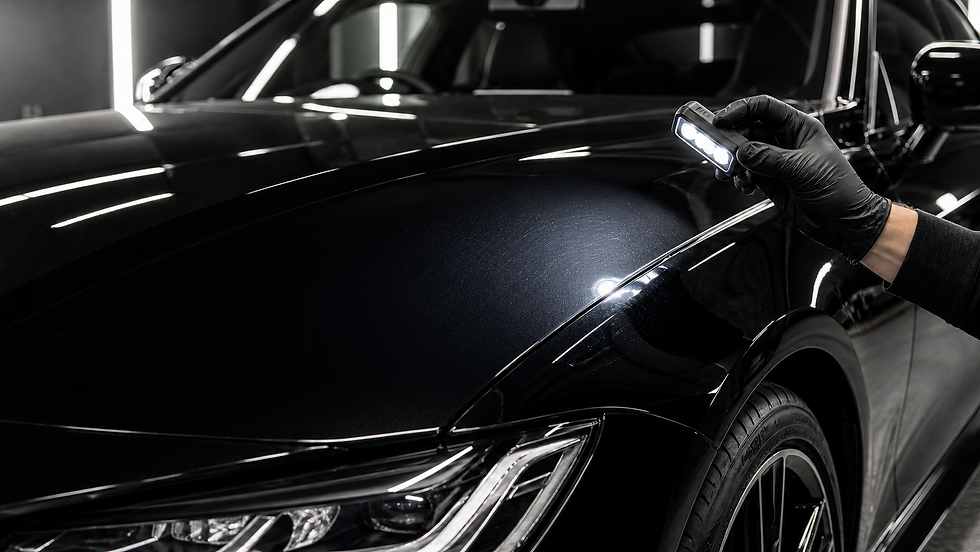
Every time heavy defects are machine polished out of a car, a tiny amount of that clearcoat is removed.
Proper paint correction is perfectly safe when the condition of the paint is assessed properly.
But the aim shouldn't be to repeatedly remove paint year after year.
The better approach is to correct it properly, maintain it properly and reduce the amount of damage happening in the first place.
That is one reason ceramic coatings make much more sense today than many people realise.
Why are more people putting ceramic coatings on new cars?
Ceramic coatings used to be something mainly discussed among detailing enthusiasts.
Now customers are asking about them before they have even collected their new vehicle.
Part of that comes from better awareness.
But modern vehicles also make paint preservation increasingly logical.
If the clearcoat is the valuable surface protecting everything underneath, it makes sense to add another functional surface on top of it rather than constantly polishing the factory paint itself.
A proper ceramic coating doesn't magically turn paint into armour.
And it doesn't make a car stone-chip proof.
What it does is create an extremely thin protective surface bonded to the paint.
Gtechniq, for example, describes Crystal Serum Ultra as forming a coating that chemically bonds to the vehicle surface and provides increased chemical, swirl and contamination resistance.
Hydrophobic coatings such as EXO are then designed to improve water and dirt repellency and make maintenance easier.
That last part is important.
A good coating isn't only about water beading for social media videos.
Its biggest everyday benefit can be making the vehicle easier to safely maintain.
If dirt releases more easily, you don't need to scrub the paint as aggressively.
If contaminants are sitting on the coating rather than directly on the factory clearcoat, there is an additional surface taking that exposure.
And if the car is easier to wash properly, there is less reason for harsh cleaning methods that create swirls and marring.
But ceramic coating has limits
There is a mountain of nonsense surrounding ceramic coatings online.
They don't make paint indestructible.
They won't stop a rock travelling at highway speed from chipping the bonnet.
They won't prevent someone dragging a dirty sponge across the car from scratching it.
And they don't mean the vehicle never needs washing again.
Even Gtechniq's professional coating warranty specifically excludes things such as stone chips and scratching caused by poor washing practices.
For serious impact protection, Paint Protection Film is the more appropriate product.
Ceramic coating and PPF solve different problems.
So is modern paint worse?
Not necessarily.
In many ways, modern automotive paint technology is vastly more advanced than what manufacturers were using decades ago.
Corrosion protection is sophisticated.
Colour technology is incredible.
Robotic application is extraordinarily precise.
Modern coatings can deliver impressive chemical, UV and weather resistance while using less energy and generating less waste.
But efficiency has changed the game.
Manufacturers are becoming extremely good at applying the amount of coating required, rather than simply applying more material.
That means today's paint deserves to be treated as a precision-finished surface rather than something with endless material available to cut and polish.
The paint might only be around the thickness of a human hair from metal to surface.
The clearcoat we actually work with is only a fraction of that.
That is why measuring paint before correction matters.
It is why proper washing matters.
And it is why protecting a good factory finish before it becomes heavily damaged can make far more sense than trying to rescue it years later.
At Elite Auto Care, that is how we look at paint protection.
Not as something designed to make a car invincible, but as a way of preserving as much of the original finish as possible while making the vehicle easier to maintain properly for years to come.


Comments